



THE DRAWN EVIDENCE™ CAPSTONE
Build a live case architecture.
Investigation is rarely a single skill. A live case may require visual reconstruction, open-source research, network analysis, witness documentation, threat assessment, formal complaints, public communication, and the disciplined organization of evidence across jurisdictions.
Live Case Architecture is where those disciplines converge.
In the Drawn Evidence™ capstone, participants learn to organize a complex matter as a coherent case architecture: separating allegation from established fact, preserving source provenance, identifying evidentiary gaps, mapping relationships, documenting witnesses and threats, and deciding what information belongs in investigative, legal, public, or protected channels.
The objective is not to collect more information.
It is to build a case that another person can understand, examine, test, and continue.
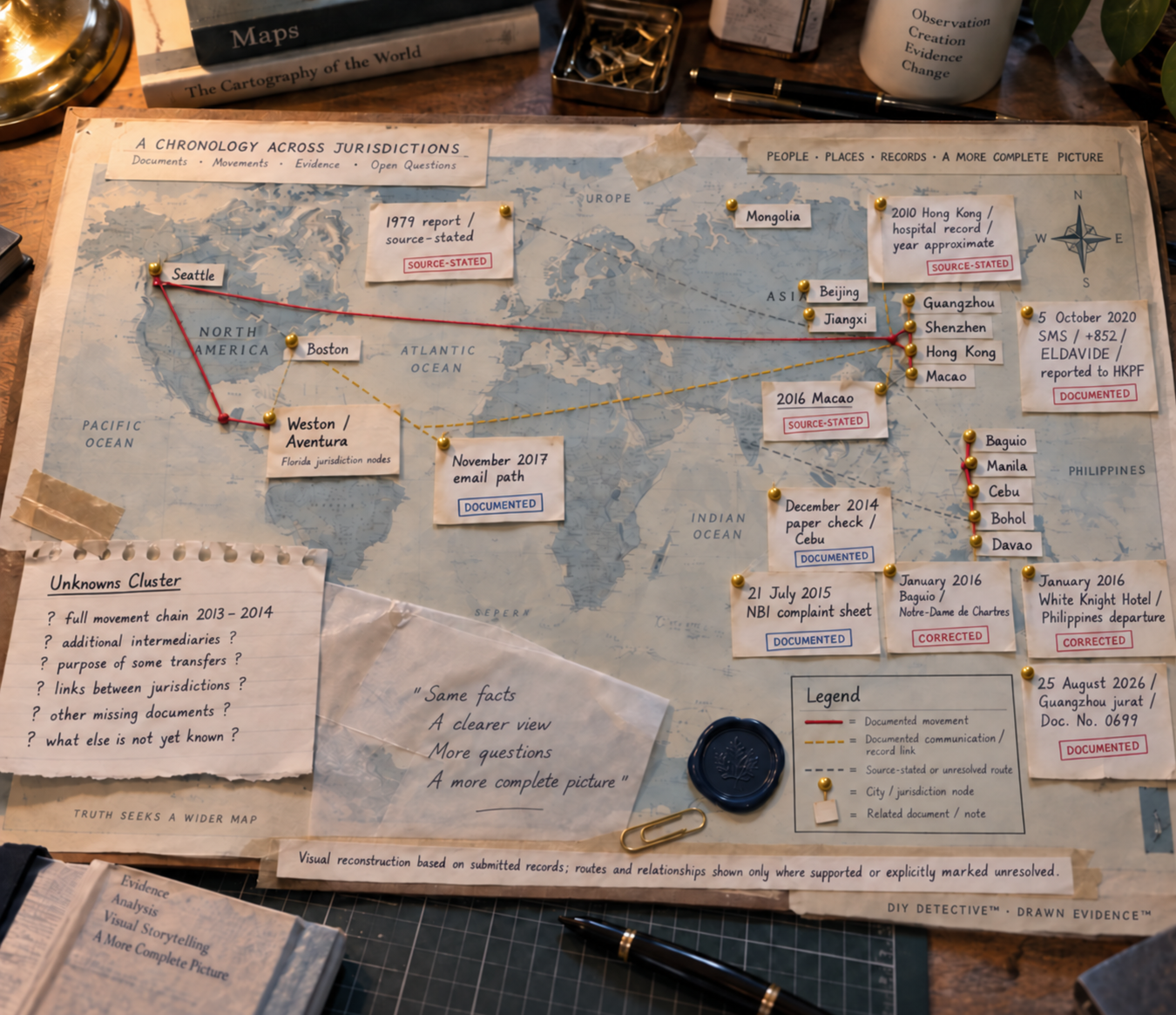
EXHIBIT A
VISUAL INTELLIGENCE & RECONSTRUCTION
Forensic sketching · Visual OSINT · Investigative story mapping
Turn observation and fragmented information into structured visual evidence.
Participants reconstruct people, places, events, objects, and relationships through forensic drawing, visual open-source intelligence, timelines, diagrams, and investigative story maps.
This is not illustration for decoration. Visualization is an investigative instrument. It shows what is known, what is alleged, what remains uncertain, and where further evidence may exist.
EXHIBIT B
NETWORKS, SOURCES & FIELD INVESTIGATION
Suspect networks · Social intelligence · Dual networks · Field documentation · Undercover observation
Cases are shaped by relationships.
This exhibit shows how to identify relevant people, institutions, intermediaries, communications, locations, and potential sources—then organize those connections without treating association as proof.
Participants build source networks alongside suspect networks, document field observations, evaluate open-source leads, and test whether corroboration strengthens or disproves a working hypothesis.
EXHIBIT C
WITNESSES, VICTIMS & PROTECTED INFORMATION
Witness statements · Affidavits · Victim advocacy · Whistleblower protection · Family support
Human evidence requires particular care.
Participants document witness accounts, organize affidavits and supporting records, distinguish firsthand knowledge from hearsay, protect sensitive information, and keep clear provenance for material supplied by victims, witnesses, whistleblowers, and families.
The record must preserve evidentiary value and human context at the same time.
EXHIBIT D
SAFETY & THREAT DOCUMENTATION
Threat recognition · Personal safety · Protective documentation
Investigative work can involve uncertainty, intimidation, harassment, or perceived and actual threats.
This exhibit teaches systematic documentation of threatening events: preserving communications, recording chronology, identifying witnesses and corroborating records, separating observation from inference, and determining when information should be referred to appropriate authorities or professional resources.
Good threat documentation does not amplify speculation.
It converts uncertainty into information that can be assessed.
EXHIBIT E
PUBLIC ACCOUNTABILITY & COMMUNICATION
Criminal complaints · Reward campaigns · Tip lines · Media documentation · Public speaking · Social campaigns
Evidence has different audiences and different disclosure rules.
Participants learn how investigative material can become structured complaints, evidence indexes, public-interest documentation, media materials, tip and witness outreach, presentations, and accountability campaigns—while keeping allegation, evidence, attribution, and verified fact distinct.
The governing discipline is controlled disclosure: what to communicate, to whom, for what purpose, and with what supporting record.
EXHIBIT F
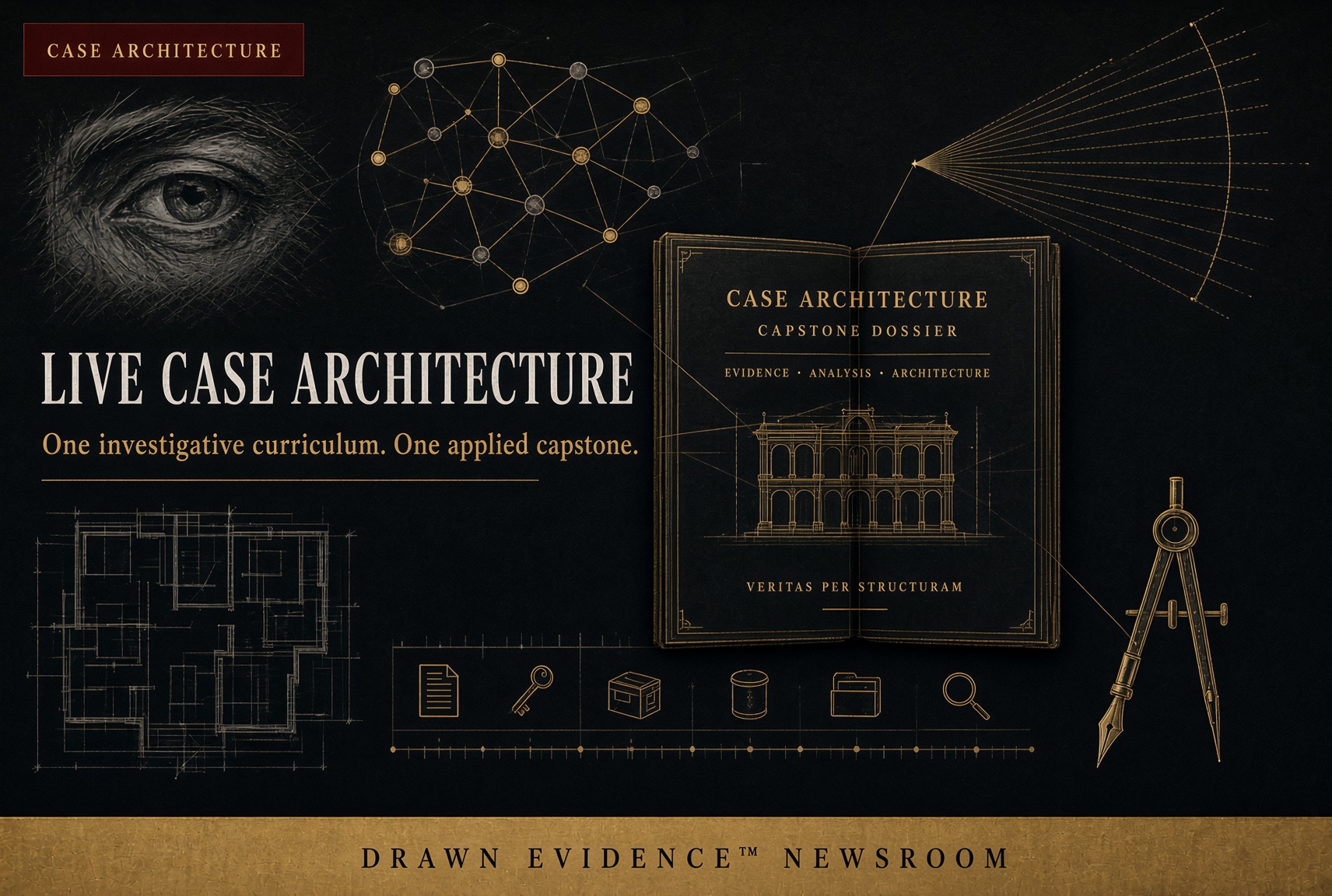
LIVE CASE ARCHITECTURE
Evidence integration · Source control · Jurisdiction mapping · Case chronology · Investigative coordination
The capstone brings the preceding systems together.
Participants organize a live or realistically structured case into one architecture connecting people, events, documents, jurisdictions, witnesses, communications, investigative questions, and evidentiary status.
Contradictions are not hidden. Missing evidence is identified. Competing explanations remain visible where the record does not resolve them.
The finished architecture should allow a student, journalist, investigator, attorney, advocate, or other authorized reader to understand:
What happened?
What is alleged?
What is independently documented?
What remains unknown?
What evidence supports each proposition?
What should be investigated next?
That is the purpose of Live Case Architecture.
HOW TO USE THIS AS A LIVE CASE
This Newsroom extends the capstone beyond the classroom.
Selected complaints, exhibits, correspondence, timelines, visual reconstructions, jurisdictional records, and later case developments may appear here as documented case material.
Readers can follow how a complex record develops over time, and how new information changes—or fails to change—the working architecture.
Source documents retain their original evidentiary status. Sensitive correspondence or identifying information may be withheld, redacted, summarized, or excluded.
As the record develops, dated updates can be added without rewriting the history that preceded them.
The case remains open to evidence—including evidence that challenges the working theory.
CORRECTIONS ARE PART OF THE RECORD
Drawn Evidence™ preserves earlier filings rather than silently rewriting them.
When new evidence, chronology, or source review requires clarification, the correction is added as a dated supplemental record.
This allows participants to study not only the evidence, but also how an investigation is responsibly refined over time.